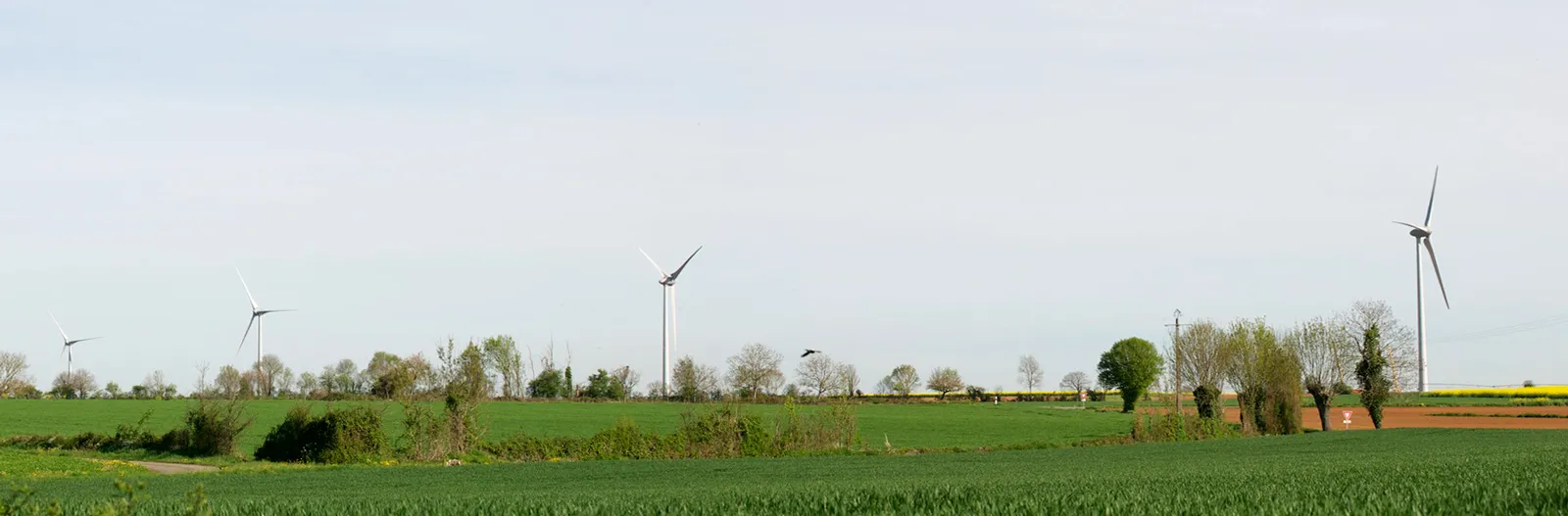
Generally speaking, people think that wind turbines are beautiful and will help us move away from nuclear power: hooray! And those who oppose wind turbines are seen as nitpickers—people who could sacrifice their own interests for the greater good. But what if that greater good didn’t actually exist?
Selected and edited by Daphnée Leportois
Reading time: 4 minutes
Opposition to Industrial Wind Power in France
develops independently of any political influence or dogmatism regarding nuclear energy. Its sole purpose: a deep respect for rural areas, natural resources, biodiversity, landscapes, and silence—and a commitment to preserving these areas for future generations rather than mortgaging them for immediate financial gain. 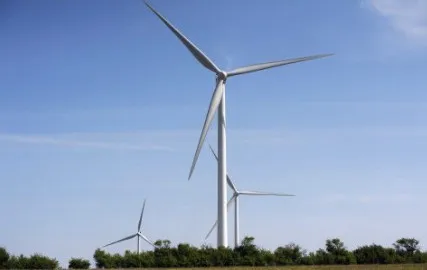 The “Porte de France” wind farm, located on the hills above Bousbach in the Moselle department, was inaugurated on May 7, 2011.
Because it’s all about money
. Thanks to government subsidies, wind energy is hugely profitable for a handful of multinational corporations. To install wind turbines, forests are cleared where they get in the way, protected natural areas are paved over to make way for access roads as wide as highways to transport and maintain the massive machines, and the subsoil beneath large freshwater reservoirs—such as the Massif Central—is excavated to dig the foundations for ever-taller towers.
So much for the environment. Magnificent landscapes are being replaced by industrial parks; birds are flying away to nest elsewhere; springs are lost forever; and to truly appreciate the noise, you have to live near one of these parks (the accounts from nearby residents are damning): it’s piercing, incessant, and unbearable.
The fact that some operators are forced to shut down their machines at night so people can sleep proves this.
The Impact on Tourism, Commerce, and Crafts
are dramatic because no one wants to live near a wind farm, as evidenced by the 20- to 30% drop in property values triggered by the commissioning of a wind farm or even the mere confirmation of a project.
Developers claim the opposite, despite the case law. The damage is also social in nature. EDF itself confirmed this at a recent seminar : “Violent opposition to wind power has emerged in certain villages in Seine-et-Marne, to the point of disrupting social ties (broken family ties, the breakdown of community life, physical violence, damage to property, etc.).”
Since the same causes produce the same effects, the social fabric is being torn apart in all the affected villages. And now there is talk ofpotential impact on public health.
We’re in the midst of sustainable destruction. 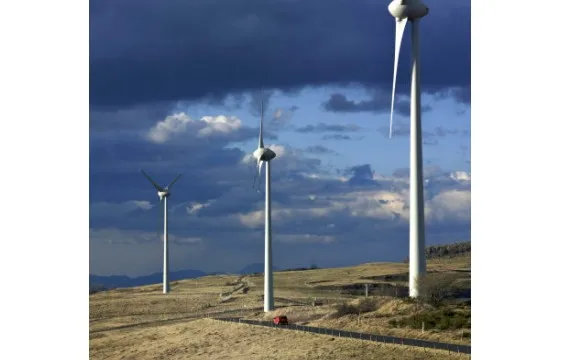 The Ardes Plateau Wind Farm, in the Puy-de-Dôme department.
Let’s move away from industrial wind power before it’s too late
To understand why some people might oppose industrial-scale wind power generation, we must first move beyond the cliché that pits wind power against nuclear power.
No, the anti-wind power movement isn’t in favor of nuclear power. This stereotype is all the more outdated given that the major wind power companies, which are grouped together within the powerful Renewable Energy Union who enjoy portraying wind power opponents as terrible reactionaries are also major players in the nuclear industry in France and abroad: GDF Suez, EDF, AREVA, and Alstom.
Wind power is all the rage in urban circles, which accuse us of protecting our own interests at the expense of the public interest. But what is the technical and economic justification for this infrastructure? Developers cling to every national and global cause to make the project palatable, spreading misinformation and playing on people’s fears: 1) reducing CO2 emissions, 2) creating jobs, 3) providing an alternative to nuclear power.
1. Wind power does not reduce CO2
Even on a large scale, the contribution of this energy to reducing greenhouse gas emissions would remain entirely negligible (it’s like trying to cool the ocean with ice cubes from an aperitif); furthermore, it indirectly increases CO2 emissions because the intermittent nature of wind power requires—at the level of an entire power system—that wind power generation capacity be supplemented by highly flexible generation capacity that can be quickly started up and shut down, namely thermal power plants burning fuel oil, coal, or natural gas.
2. Does wind power create jobs?
Building wind turbines in France would certainly create jobs (which is not yet the case), but the overall assessment must take into account the job losses caused by the wind power industry as it slowly kills the local economy—particularly tourism.
The inscription of the Causses and the Cévennes on the UNESCO World Heritage List on June 28, 2011 reminds us, if we needed reminding, that France is the most visited country in the world and that the beauty of its landscapes plays a major role in that.
3. Wind Power: An Alternative to Nuclear Power?
As for phasing out nuclear power, we need to look beyond wind power: given the capacity of each turbine (about 2 megawatts) and the unpredictability of the wind (a turbine’s annual efficiency is barely 30%), we will have covered France with wind turbines, disfigured the landscape, and destroyed an entire sector of our economy—all while the financial gains from wind power will go toward bolstering investments in nuclear power in France or elsewhere, since it is part of the same industrial and transnational sector.
If this is in the public interest, why put a price on the consent of municipal councils? Systematically compensating municipalities, while simultaneously contributing to their impoverishment, is an admission of the damage and nuisance caused by industrial wind power and proof of its technical and economic absurdity.
If this industry is so useful and harmless
, so why isn’t wind power being generated in the Luberon, on the French Riviera, at Cap Ferret, on the Île de Ré, in Saint-Barthélemy, or even in the Larzac region?
Why aren’t machines installed in urban areas—why not in the Bois de Boulogne and the Bois de Vincennes? The answer, which is all too obvious, reveals an unprecedented contempt for a large portion of the rural population.
So let’s set the record straight: the public interest is represented by opposition to wind power, while private interests are embodied by the developers, backed by the government. Let’s put a stop to this assault on rural France.