The tea ceremony is a Japanese tradition characterized by refinement and respect for the host.
June 9, 2012
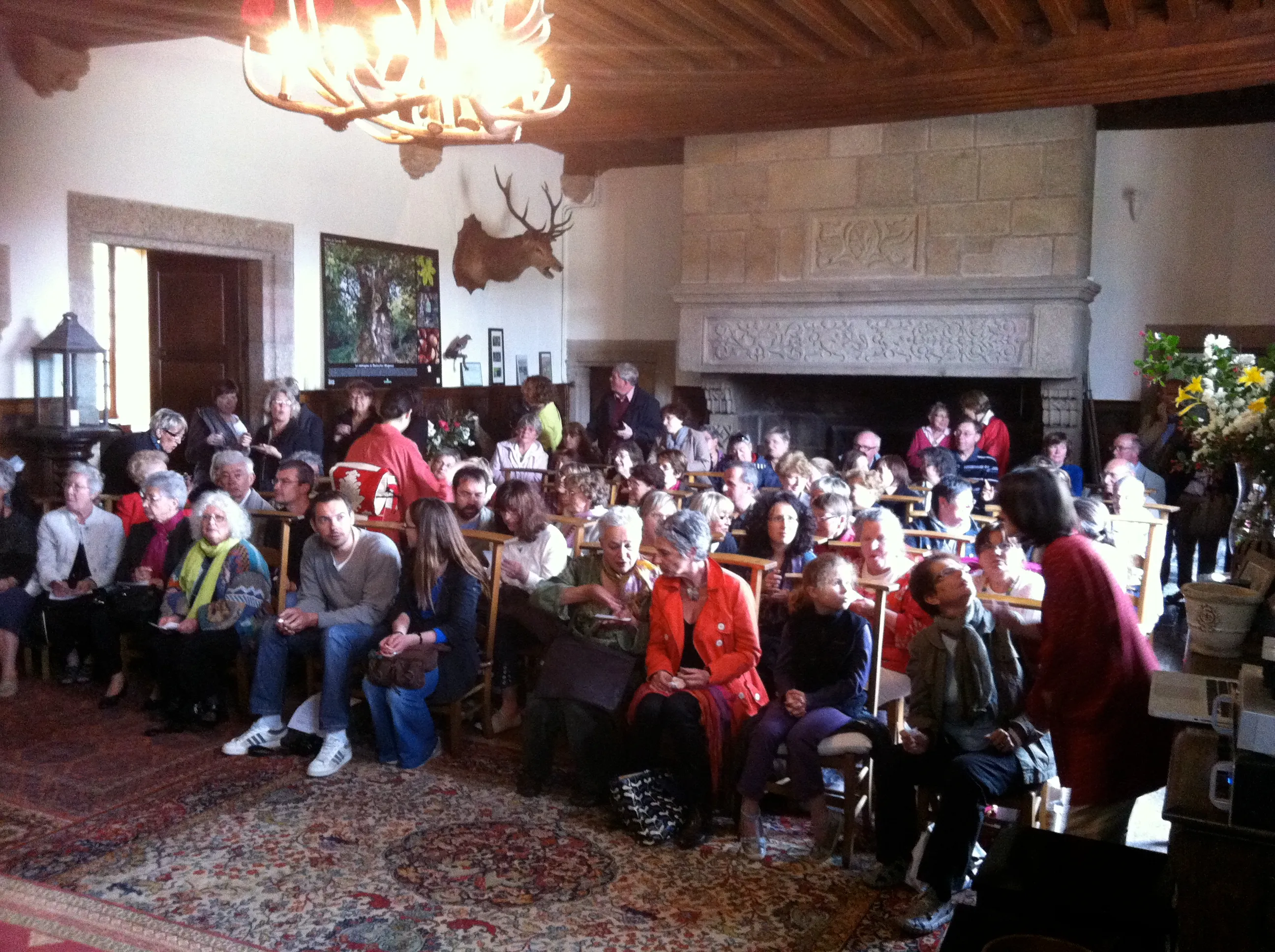
, it was a first for Masako—who had earned the title of “Master” in the art of preparing and serving tea—to do so in a castle. 
 What a happy coincidence!
The room’s decor was perfectly suited for Yoko—a dancer before she became a hairstylist—to create this Japanese bun!  The owners, backed by a great team!
During the tea ceremony, everyone was captivated by Masako’s respectful and delicate movements. Silence fell naturally so that everyone could fully immerse themselves in this magical moment and etch it into their memories.
Here’s Masako’s journey to becoming a tea master! “I began learning the ‘tea ceremony’ at the age of 15. My initial motivation was to be able to enjoy the delicious, delicate Japanese sweets—‘wagashi’—that are served during the ceremony.”
The tea ceremony is a practice in focusing the mind while setting aside the body; through the preparation of tea, one allows one’s heart to express itself. In preparing tea, the most important thing is to be attentive, adopting an attitude of care toward those present.
Every movement is elevated; even the smallest one is significant and carries profound moral value. Stepping away from the hustle and bustle of daily life to take the time to attend a tea ceremony means leaving one’s worries behind and entering a state of contemplation that soothes and calms the heart.
We focus and forget everything else. The tea ceremony is culturally rich because it brings together all the traditional Japanese arts: tatami mats, scroll paintings and calligraphy, flower arrangement, the hearth, tea utensils and sweets, silk fabrics, and kimonos.
People sometimes ask me if it isn’t boring to repeat the same actions over and over. It’s true that the sequence of actions is always the same, but the guests, the places, and the seasons come and go, and they’re all different.
“I consider every encounter to be a unique, priceless gift of life. It is in this spirit that I would like to introduce you to the tea ceremony.” 

 Yôko serves tea while Masako, with her husband’s help, bustles about in the kitchen preparing it for 80 people!
Maï lends him a hand. It’s a great warm-up for the dances that are coming up…

 Some people, intrigued by the multi-pleated belt, asked for a demonstration of how to tie it around the waist.
Yôko and Kaori happily went along with it, doing so with great grace.  Yôko had prepared a classical Japanese dance repertoire, but she also surprised us by adapting it to “Hymne à l’amour,” sung by Edith Piaf!
A whirlwind of emotions…  Before saying goodbye, everyone had a chance to try a few dance steps under the guidance of our talented and charming Japanese instructors.
I hope you have a lovely, sunny day, and thank you again for your warm and generous hospitality. Elisabeth Charlot P.S.: I didn’t have time, but I would have liked to write something like this in the guestbook: “Ronsard’s roses, in their elegant spring finery with a fragrance lighter than a whisper, witnessed the Japanese spirit making its entrance into the heart of the Château de Bourgon, under the kind and attentive gaze of the hosts…” 