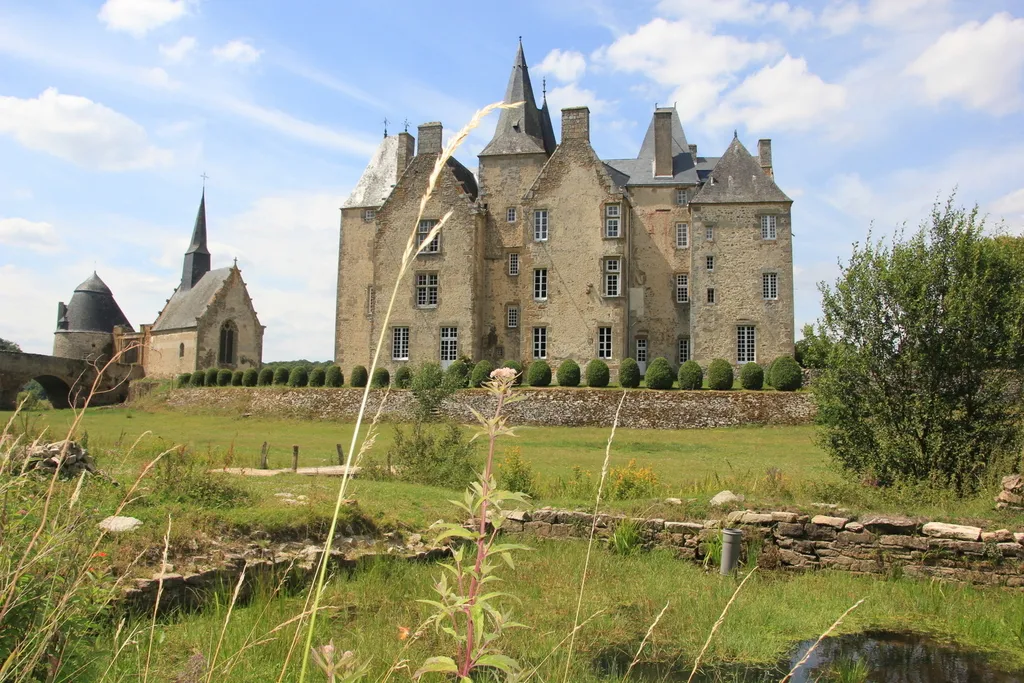
JEP 2015 at the Château de Bourgon-Montourtier, 53150 Montourtier. **Saturday, September 19, from 10 a.m. to 12 p.m. and from 2 p.m. to 6 p.m., and Sunday, September 20, from 10 a.m. to 12 p.m. and from 2 p.m. to 3 p.m. (last departure)
). Château de Bourgon, Route de la Forêt—toward Belgeard, Montourtier.
Contact: Tel. 02 43 02 16 20, 06 09 62 99 08, [email protected], https://www.chateaudebourgon.com.
Guided tour of the castle (fee required); reduced rate of 10€ per person; children free
t,** free carriage rides* after the guided tour***.  Arrival on the bridge in a horse-drawn carriage
  Bourgon au naturel
Free Activities : ”
“Discovering Wild Plants”
with
Marie Girard,
“edible, poisonous, medicinal”
only on Saturday the 19th at 3 p.m., Duration: 2 hours; complimentary tea.  viperine For example, you’ll discover the viperine! It is a biennial, erect, hairy plant with leaves featuring a single prominent vein; the basal leaves are petiolate, oval-lanceolate, while the upper leaves are sessile and narrow.
The color of its flowers varies depending on their stage of development, ranging from pink when in bud to bright blue when fully bloomed. They are arranged in scorpioid corymbs with five very prominent, unequal stamens (with red filaments and yellow anthers).
There is a “white” variety (albiflora). It produces very small seeds (400 seeds weigh 1 g). It is a honey plant.
This plant is exceptionally attractive to bees, bumblebees, and butterflies. It provides them with an abundant supply of nectar for several consecutive weeks. One hectare of viper’s bugloss yields 300 to 400 kg of excellent honey.
It thrives in poor (shallow or even stony) soils with a tendency toward calcareous conditions. According to the theory of signatures (corollas with uneven lobes that vaguely resemble open jaws, and stamens that resemble a snake’s tongue, while the styles resemble a tail), this plant was used to treat viper bites.
In fact, it contains a paralyzing alkaloid similar to curare—such as echine or cynoglossine—but in such a small amount (0.0017 percent of the fresh plant’s weight) that it is harmless to humans.
However, it is used in herbal medicine as an infusion to soothe a cough (dried flowers with depurative, pectoral, and diuretic properties).
P. Nigault Painting Exhibition  Pierre Nigault: Preparations—The Soul of Greek Houses. Pierre Nigault lived in Greece for 29 years and held numerous exhibitions there.
The theme of the 2015 exhibition in Sainte-Suzanne was first presented in Ermoupolis on the island of Syros, at the Cyclades Art Gallery, in September 2001. It is based on the multiplication and division of images and forms.
It contains forms intertwined through time, each asymmetrical in relation to the others—just as in the folktales, faith, and beliefs of the Greek people. Rich folkloric and mythological elements evoke memories and give rise to stories.
This dreamlike and poetic imagination reflects a powerful reality of the long journey the Greek people have undertaken: living houses travel through eternity; mountains, rocks, coastlines, and the sea come together, sit down to eat, and coexist.
In harmony—eyes as windows, hair as rooftops, hands as beams—they jostle one another in their stillness. The vessel called Greece sails through the channel of immortality, serene with its precious cargo—beings and houses—a reflection of its existence. Scholarly, watchful gazes, full of perseverance and beauty, transport us and tell us their stories.
Symbolism and allusion are everywhere.