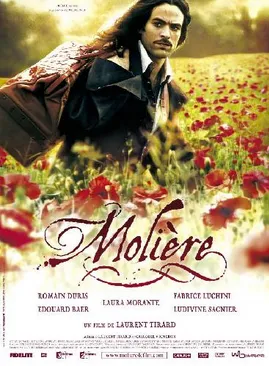
 “Molière” movie poster A brief overview of the movie’s synopsis: http://www.premiere.fr/film/Molire The magnificent film “Molière,” starring Fabrice Luchini and Romain Duris, will be screened as an “open-air movie” on July 15 at 10:30 p.m. at the Château de Bourgon-Montourtier. organized by the Pays d’art et d’histoire Coëvrons-Mayenne at an exceptional location!
*A nod to Molière, who made a “fool” of the précieuse, the owner of the estate: the Marquise de Sablé! *The film screening will be preceded by a group picnic on the castle esplanade starting at 8:00 p.m. Everyone should bring their own picnic basket, drinks, and a blanket to set up on the grass. Wikipedia Summary: In 1645, Molière, who was directing the “L’Illustre Théâtre” troupe, found himself in prison because of unpaid debts.
He is rescued from prison by Monsieur Jourdain, a wealthy bourgeois who wants to hire him to help him win over Célimène, a prominent marquise at court. Monsieur Jourdain, who dreams of becoming a gentleman, plans to perform a play he has written for Célimène.
In his efforts to build a bridge between the court and the nobility, Monsieur Jourdain believes he is being helped by Dorante, “his friend,” a nobleman—who is, in fact, ruined—and who turns out to be a swindler, interested solely in Monsieur Jourdain’s fortune and the debts he can collect from it.To avoid arousing Madame Jourdain’s suspicions about her husband’s schemes, Molière—who poses as a priest named Tartuffe—is hired as a tutor for the Jourdains’ young daughter, Louison.
But Madame Jourdain, Elmire, soon discovers the deception behind this identity (though she remains unaware of Molière’s true mission) after reading—and loving—a play written by Molière for her husband.
A romance blossoms between Molière and Elmire. Monsieur Jourdain, blinded by his dreams of nobility and consumed by his passion for Célimène, is completely oblivious to everything. Meanwhile, his eldest daughter, Henriette, is in love with another young man, Valère, and he has even agreed to marry her off to Dorante’s son, Thomas, hoping thereby to make her a countess and ensure that his descendants become nobles.
Neither Molière nor Madame Jourdain manages to thwart this plan for a forced marriage. Monsieur Jourdain ends up performing his play in the salon hosted by Célimène. Dorante manages to convince him that it’s a complete success, but Molière soon proves to him that Dorante has lied, that Célimène was not moved by his play, and that she is even mocking him in public.
This man—who has been mistreated, mocked, and ridiculed—then discovers that his wife has a lover, yet remains oblivious to the world around him. At the cost of his own feelings and his affair with Elmire, Molière makes him realize that he is that lover and brings him back to reality.
On the day of Henriette and Thomas’s wedding, it is revealed—right in the middle of the ceremony—that all of Monsieur Jourdain’s warehouses have burned down and that he is now a ruined man. Upon hearing this news, Dorante decides to leave with his son and call off the wedding—further proof of his greed and his lack of affection for “his friend.”
Shortly afterward, we learn that it was Monsieur Jourdain who orchestrated this whole affair in order to expose Dorante. He then brings Valère in, and the happy marriage of love is sealed. Molière leaves, and the Jourdain family can regain a sense of balance.
The actor eventually returned to Paris to reunite with his friends and a theater troupe. They went on tour throughout France for many years. They did not return permanently until 1658, when Molière’s troupe was granted the protection and support of Monsieur, the king’s brother.
His troupe was now known as “Monsieur’s troupe.” It was from this point on that Molière’s great career as a playwright, actor, and director began. It was also there, in Paris, that he saw Elmire again, gravely ill and on her deathbed.
She forgave him for leaving and for sacrificing their relationship. 