 Let’s go!
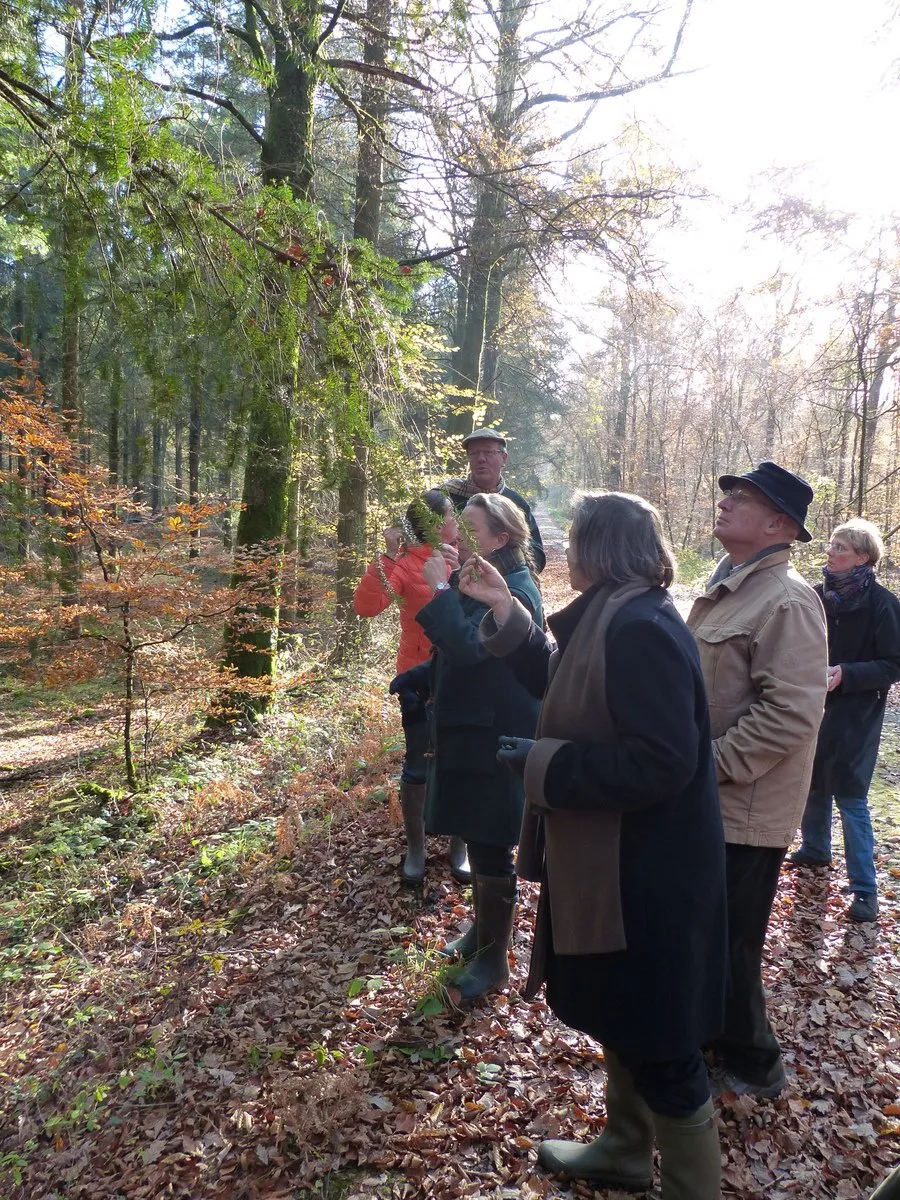
There’s nothing like taking a walk down an inviting forest path to get some fresh air and learn something new… Let the walk begin…
Questions quickly start pouring in: How can you tell certain tree species apart when they look so similar…
For example, what are the differences between the pedunculate oak and the sessile oak:
Stalked: The acorn, along with its cupule, is attached to the branch by a long stalk; in contrast, the leaf is attached by a short petiole or stem. The acorns are well separated from one another.
Oak or sessile: The acorn has a short stalk, but the leaf has a long petiole. On the branch, the acorns are clustered together in egg-shaped clusters.
 English oak or sessile oak?
 But who is hiding behind that shrub?
 The Magnificent Pheasant
 The revered hen Wildlife brings the forest to life and delights hikers.
But who’s hiding behind that shrub? Hide? Not me… This bold, revered pheasant can sometimes be aggressive, but today he’s decided to strut his stuff and show us his magnificent plumage—the male’s tail can reach up to 2 meters in length!
More cautious, perched on a branch, she admires her beloved!  Chestnut-colored coprinus \
As we round a bend in the path, some strange mushrooms catch our eye… but watch out! You should be wary of these beautiful specimens—they’re magpie mushrooms, which aren’t recommended. They’re a mediocre edible; their flesh is very thin and turns to liquid very quickly, and their smell is frankly unpleasant.
It is easily recognizable by its colorful cap—which eventually spreads out as it tears apart before disintegrating (breaking down and turning into a liquid)—and by its stem, which is often quite large.
It can be found from June through November in the leaf litter of deciduous forests, with a preference for beech trees; it is rarer under conifers. Uncommon. It’s always a pleasure to come across it.
 Deep in the forest, we come across a grove of oak trees—majestic! Stately!… The locals who live near the forest have named this grove “The Four Brothers” because the trunks, which grew from the same stump, are uniform and, above all, very similar.
These trees are over 150 years old and have been recognized by the A.R.B.R.E.S. association, which awards a designation to catalog and preserve certain exceptional specimens. A grove of oaks: the “Four Brothers.” And what can you make out in the middle of the grove?
 Peat bog A micro-peat bog! It is a wetland where peat forms through the accumulation of plant debris. Peat bogs, like most wetlands, were once considered nothing more than putrid, unsanitary, eerie, and dangerous swamps, with stagnant waters carrying miasmas and populated by sinister and malevolent creatures…
It was essential, at all costs, to drain and reclaim them in the name of public health. It is only very recently—in the last thirty years or so—that we have been able to better identify and understand the major role these environments play and acknowledge the value, and indeed the necessity, of their conservation.
Located at the interface between terrestrial and aquatic environments, peatlands are incredible reservoirs of life.  A Percheron in the Mist
  A herd of Percheron horses. Out of the mist emerges a Percheron, steam rising from its nostrils!
In harmony with the forest, these forces of nature help with logging operations. These draft horses are impressive but have a peaceful, docile, sociable, and hardworking temperament… a dream come true for a foreman! And before long, here come the curious onlookers…Or rather, curious females: three mares and the little black filly.
It’s important to know that Percheron horses are all born “black” and, depending on their genetics, turn white more or less quickly, going from gray to a piebald or spotted coat—sometimes with star markings. Speaking of which, the little filly is named…
Deneb! It’s actually “cosmic”… she’s named after a star called “Deneb”: the brightest star in the constellation Cygnus… who said that wasn’t a horse’s name? Isn’t she gorgeous?
 A Remarkable Chestnut Tree—One surprise after another… Take a close look at this tree trunk… A face is naturally carved into it—Mother Nature is watching us!
This 300-year-old chestnut tree has been designated a “remarkable” tree, so it will be protected for life. How lucky! Let’s keep talking about trees—or rather, an avenue… Here’s a riddle: What is an avenue of pollarded trees?
 Avenue of pollarded trees It is not the tree species that defines a “pollarded tree”… but its regular and severe pruning. Most often, willows and oaks were pruned this way for timber production; they are also called “tétards.”
Here, three rows of linden trees form a shaded, fragrant walking path… That really whets the appetite… This marks the end of this captivating and informative stroll; it’s time to head back to the castle for a hot chocolate by the fire… a wood fire, of course!
 The forest serves as a lush green backdrop to this gem of an old stone building