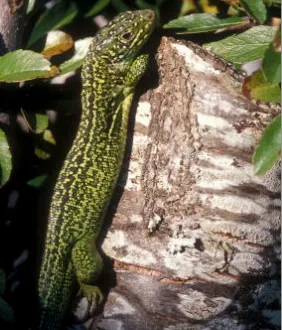
 The green lizard was spotted twice in 2011 during morning outings with ecological engineer David Quinton. It is still in the same spot—very elusive—at the corner of a path in a bush, on the edge of the Bourgon Forest, near the castle.
Protected within the country, listed in Annex IV of the “Habitats” Directive and in Annex II of the Bern Convention. The green lizard depends on fairly dense vegetation cover. It is found at the edges of woods and forests, in clearings, as well as in meadows, along roadsides, and on embankments.
It is often found alongside the green-and-yellow snake, which feeds on it after a fierce struggle. It readily climbs into bushes and trees and can swim on occasion. This animal bites hard when handled.
It is an animal that is very sensitive to temperature, which largely determines its activity,
mainly diurnal
. The minimum tolerable temperature is 15°C, with an optimum of around 32–33°C. Hibernation: It hibernates from October to April in a rodent burrow under a rock or a pile of vegetation.
Diet Its diet consists mainly of arthropods and insects, particularly beetles. However, it also feeds on earthworms, mollusks, lizards (including members of its own species), and bird eggs.
We came across some green lizards eating ripe fruit.