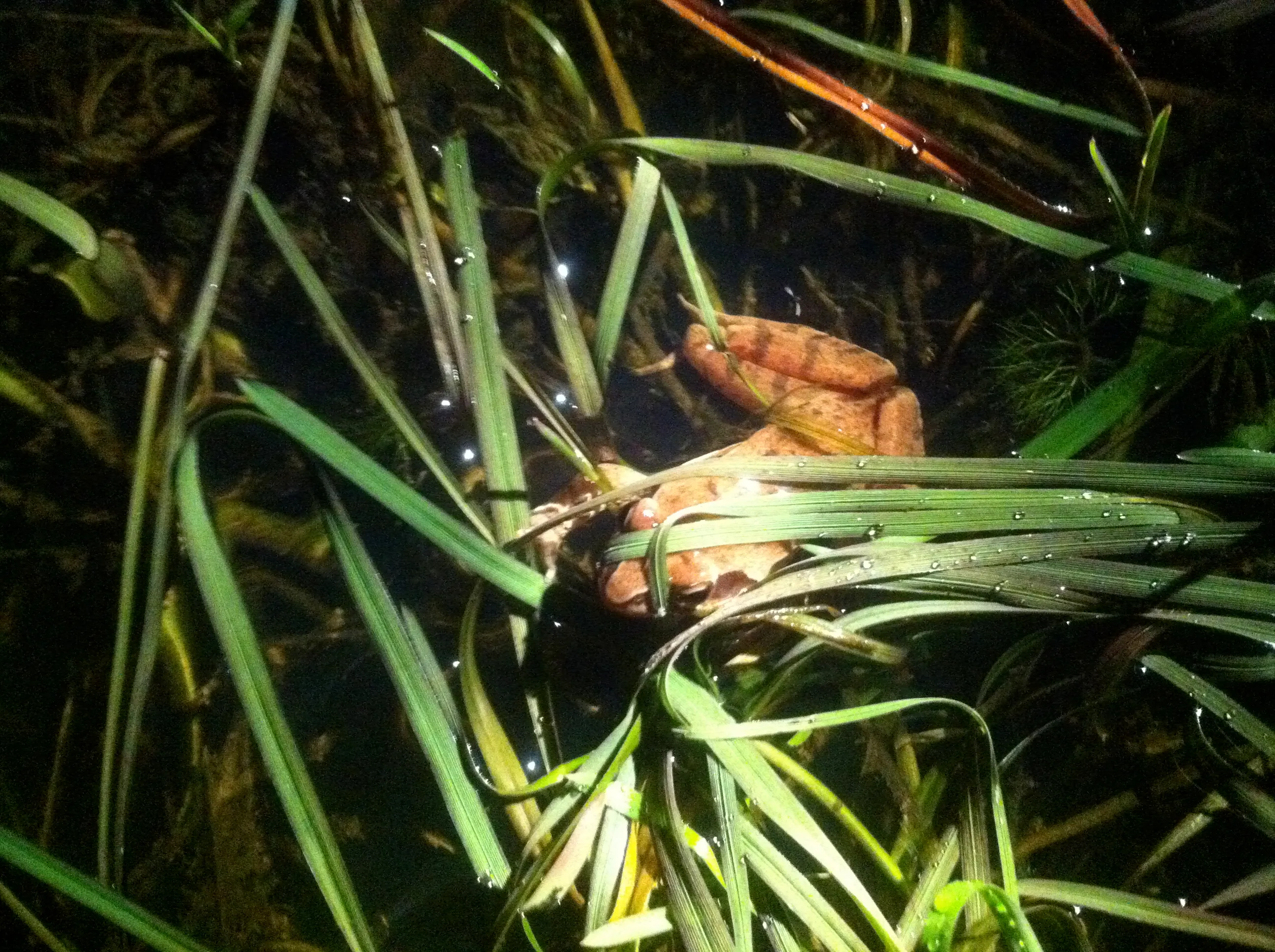
 **Observation made with Benoît Baudin, an amphibian specialist, in the castle’s former moat on the clearing side.Conservation status:** In France, the agile frog is protected by the decree of July 22, 1993 (Article 1), by the Habitats Directive (Annex IV), and by the Bern Convention (Annex II). The Red Book of Vertebrates of France lists it as a “species to monitor.”
Threats:
The fragmentation of the bocage isolates populations, which will disappear in the near future. Wet meadows are gradually being replaced by large monocultures, particularly corn.
Description: “The agile frog, also known as the masked frog”
The Agile Frog does not exceed 8 cm in length and has very long hind limbs. Its hind legs are often marked with dark transverse stripes.
A black stripe runs from the tip of the muzzle to the back of the ear. The coat is light beige or reddish-brown, with dark spots on the upper body. The underside is creamy white.
Song: “Singing Without Choking”
Its very faint call is emitted from deep underwater; it could be described as a “co, co, co”… The agile frog usually croaks at night.
Habitat: “A Forest Ranger”
The agile frog is a species found in lowland forests, hedgerows, and alluvial woodlands. It breeds in ruts, ditches, flooded meadows, ponds, and pools.
Social Customs: “Idyll in the Rain”
The agile frog is primarily terrestrial; it can be seen during the day along the edges of paths, in meadows, and in woods. The first breeding individuals (often males) are observed from late December to early January.
When conditions become optimal (rainy nights with temperatures above 8 °C), the majority of individuals in a population migrate to breeding sites. This very brief breeding period is described as “explosive.”
The female seeks out areas with an average depth of 20 to 30 cm; she presses her cloaca against the aquatic vegetation to facilitate the expulsion of the eggs. The clutch forms a compact ball of 600 to 1,400 eggs.
Special Achievements: “Gold Medal in the Long Jump”
When in danger, it can make leaps of more than 2 m. Its “dead leaf” coloration and long periods of stillness allow it to go unnoticed in its forest habitat.