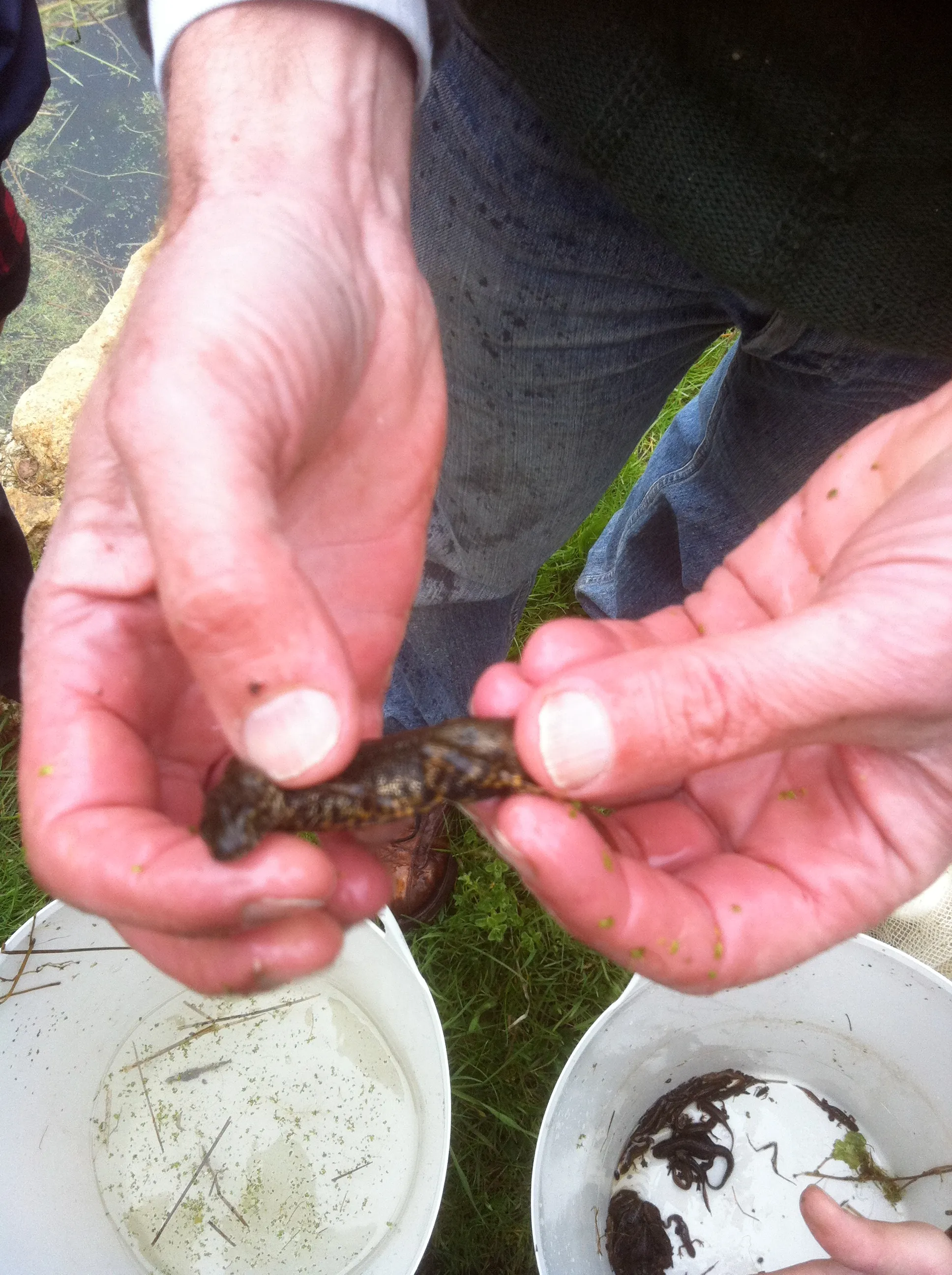
On April 17, 2012, internationally renowned scientist Pim Arntzen honored us with his presence at the Château de Bourgon and conducted a survey of the newt species present in the restored moat.  The nets are hauled in, revealing a wide variety of species: palmate newts, marbled newts, crested newts, and… the hybrid!—an extremely rare cross between the marbled and crested newts.
Triton, also known as Blasius or Trouessart, depending on whether the female is marbled or crested.
How can you tell them apart?
 The smallest is a palmate newt, the medium-sized one is a male marbled newt, and the largest is a female crested newt.
The webbed newt, the most common species
: 

The marbled newt, which is black and green, is much less common. 

 Triturus marmoratus measures between 120 and 150 mm, making it a newt large for a European species.
Females are slightly larger than males. Its body is relatively stocky, with massive legs and a broad head. Its queue is quite long and flattened vertically.
The base color is black, mottled with yellow spots, especially along the back and tail and on the flanks. Females have a reddish-orange line running along the spine. In males, this line is dotted with black and forms a crest during the breeding season.
At the European level, the marbled newt is listed in Annex 4 of the Habitats Directive and in Annex 3 of the Bern Convention. These annexes list animal species that are strictly protected. At the national level, it is classified as a vulnerable species in France’s Red List of Vertebrates.
The crested newt, which is just as rare:


 The crested newt is the most
big
newts. The crested newt has a
**very dark gray-black back**
, speckled with black and small white granules. Its
its belly is bright yellow
, yellow-orange or orange
speckled with large black spots
. It’s the most
The largest **newt in our region, reaching 15 cm in length (18 cm for females). Its head is as long as it is wide, its snout is rounded, and its strongly compressed tail tapers to a point.
The warty skin on its back is black, while its flanks are dotted with small white spots. Its belly is orange-red with black spots. Its limbs are fairly long, and its toes are elongated and free.
The skin is
warty
, which remains moist even on the ground. The male has a grayish, brownish, or blue-black back with darker spots, and a yellow or yellow-orange belly with large black spots. Its throat is gray-black, speckled with white. In the spring, the male has a
high, jagged ridge saw-toothed. The female (slightly larger) has a grayish, brownish, blue-black back with darker spots and a yellow-orange belly marked with large black spots. The dorsal groove is sometimes yellow.
The significant decline in the population of the crested newt in France over the past thirty years is due to a variety of factors: agricultural land consolidation, urbanization of the plains, road construction, water pollution, the lowering of the water table, and the filling in of ponds and their conversion into fishing areas.
Attempts to relocate populations—for example, as a result of development projects—have most often ended in failure. Only by preserving their original habitats can crested newts ensure their survival.
The Crested Newt is protected in France under the decree of July 22, 1993 (Article 1), the Habitats Directive (Annexes II–IV), and the Bern Convention (Annex II). This species, which is near threatened globally, is considered vulnerable in France.
- And what does the so-called Blasius hybrid newt look like?


 Blasius’s Triton exhibits a morphology that is somewhat intermediate between those of its parent species.
As an adult, it is a large newt, measuring between 130 and 180 mm. The upper surface of its body is greenish-black. The underside is more or less yellowish, mottled with blackish spots, and has fine whitish speckles.1.
Its colors are duller, and its patterns are fuzzier than the other two species from which it originates. The male’s crest stands upright and is larger than that of the Marbled Newt, but shorter and stiffer than that of the Crested Newt.
It is often deeply serrated. The
Blasius’s Newt
is protected at the national level. It appears on the list of species (although it is not a species but a hybrid) covered by Article 3 of the Decree of November 19, 2007. And one last surprise!
A tadpole of the midwife toad, or alyte.  The midwife toad is a small, earth-colored animal less than 5 cm long.
With magnificent golden eyes and vertical pupils, it has a stocky, very pimply body. It prefers damp, cool places: under rocks, holes in old walls, and gravel pits near bodies of water.
In our region, it is found primarily in mid-mountain areas (the Cévennes), but also in valleys, on the Causses, and even in urban areas. In mid-March, it returns to its perch (a rock or a tuft of grass) and announces its presence with a brief, flute-like, resonant call—a soft, melancholic “tüt” repeated 20 to 40 times per minute.
He sings with his mouth closed: the sound is created by a bubble of air swallowed beforehand as it moves from the chest to the larynx and back again. This is the time of year when the female goes in search of a male; mating begins as soon as the pair is formed.
The male grasps the female around the waist and, using his long toes, massages her abdomen for half an hour to help expel the 30 to 40 eggs, which will be fertilized immediately. Before the viscous mass of eggs solidifies, the male alternately dips his hind legs into it to secure the mass around his ankles.
This behavior also earned him the nickname “Alyte” (alutos means “chained” in Greek).  As a model male, he will carry this clutch on his body for more than three weeks and will go without food for more than twenty days in a hiding place where the ideal conditions for egg maturation (temperature and humidity) are present.
Next, he will release the eggs into a pond of his choosing—usually the one where he was born; when exposed to water, the eggs will hatch, releasing vigorous, carnivorous tadpoles. In total, the adult male spends barely more than six to seven hours in the water each year, and the female not a single minute!
Three or four months later, young “crapelets” will emerge from their native pond (those that hatched in the middle of summer will not undergo metamorphosis until the following year).