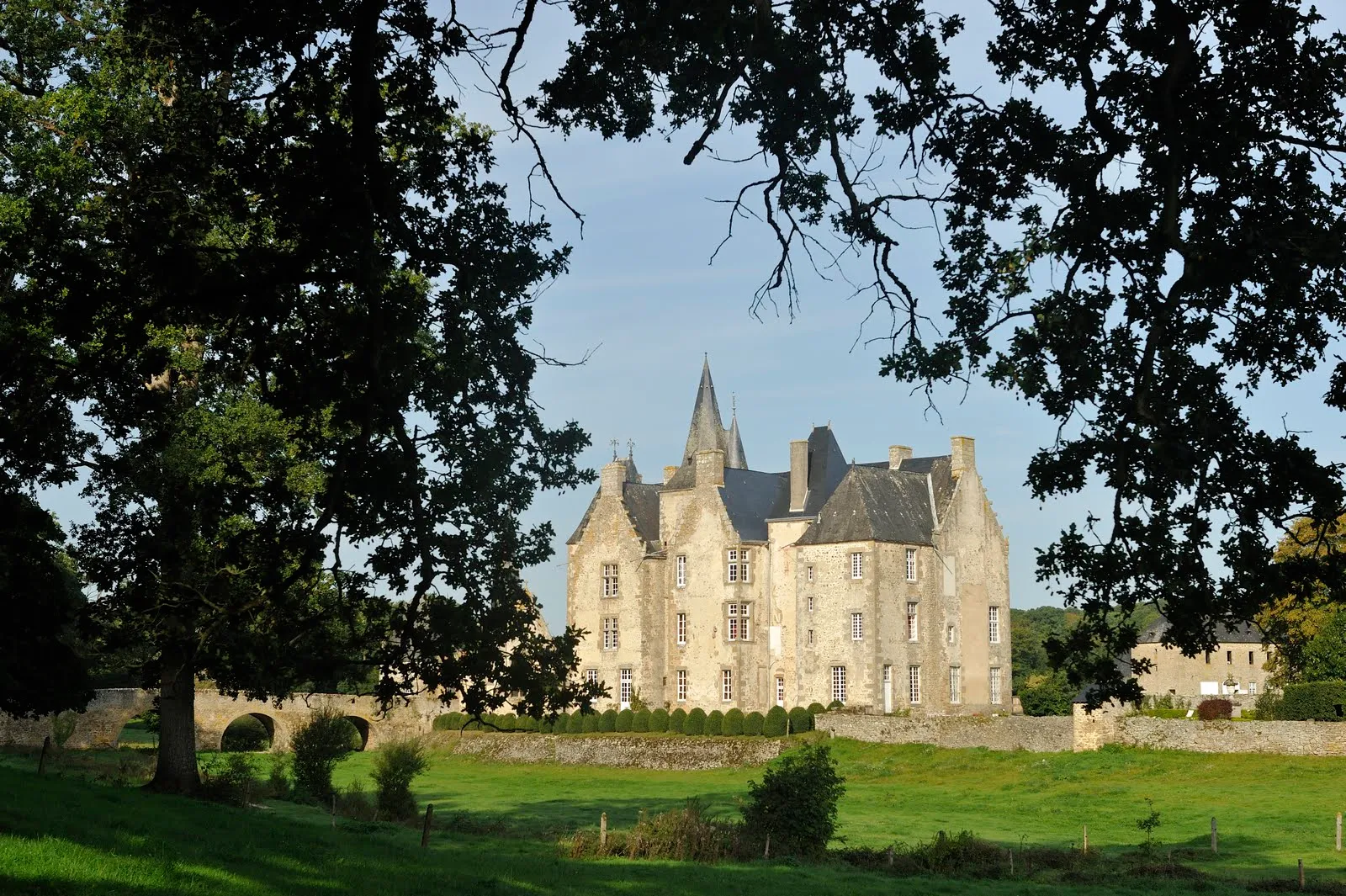
 A young grass snake at Bourgon Castle (53150 Montourtier).
A candid photo taken by pure chance! Unfortunately, young snakes have many predators: birds of prey, predatory fish, foxes… Although it’s most often found near water, the grass snake is the least aquatic of Europe’s three water snakes.
The ringed snake belongs to the Colubridae family. This snake is completely harmless to humans. Despite its high reproduction rate, the population is declining.
The collared snake is protected by law. In France, hunting, capturing, or trading this species is prohibited under the decree of April 24, 1979.
Profile of the ringed snake:
Male snakes of this species measure an average of 60 to 70 cm. Females are longer and can reach 1 m in length. Very large specimens measuring up to 2 m in length have been observed.
The collared snake is very stocky. Its coloration is generally slate gray. However, it is most easily recognized by the white or yellow crescent-shaped markings on the back of its head.
It is not aggressive and rarely bites. Its venom is toxic only to small mammals. It is harmless to humans.
Diurnal snakes have good color vision. The ringed snake has cones that are sensitive to red, green, and blue.
Lifestyle:
This snake feeds on frogs, toads, and fish. An excellent swimmer, it dives skillfully to hunt its prey. It may also feed on small rodents, but only in drier areas. It swallows its prey alive, without choking it.
However, it can also be found far from a water source. It lives at altitudes of up to 2,300 meters in the Alps. The collared snake is rather skittish; it flees when danger approaches or hisses if it feels threatened.
If you grab her, she’ll secrete an anal fluid whose foul odor will linger on you for a long time. It’s a good defense against intruders. Her other defense is to play dead.
She then rolls onto her back, goes limp, and sticks out her tongue. As soon as the danger has passed, she calmly goes on her way.
Reproduction: The female is oviparous; after a gestation period of 4 to 8 weeks, she lays about 40 eggs. She mates after her first molt. Males and females gather for courtship displays.
Up to 60 collared snakes, mostly males, have been observed in a single breeding area. The female lays her eggs around July–August in decaying vegetation. Suitable egg-laying sites are used by many females.
These mass egg-laying events can involve up to 3,000 eggs. The females do not hesitate to travel long distances to find a suitable laying site. It is likely that they return to the same site year after year.