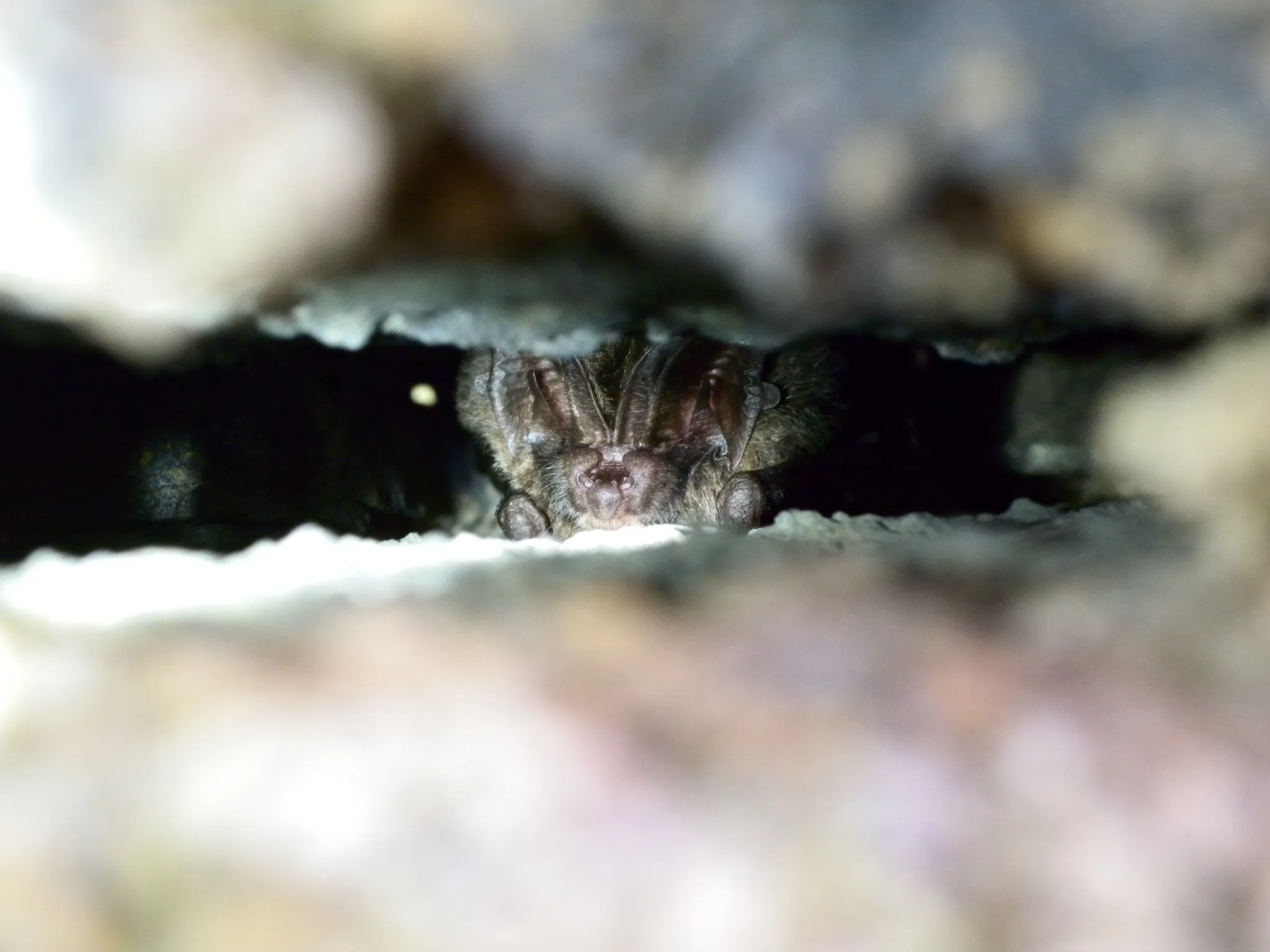
ID Environnement, in partnership with the Château de Bourgon, aims to catalog the bats living in historic monuments. Bats are drawn to nooks and crevices in stone or wooden structures; these peaceful spots serve as their preferred habitat.
A survey conducted at Bourgon Castle in May 2012 revealed at least 26 European barbastelles and their young in the stables, nestled between a rafter and the wall; and in the tower, a colony of 33 lesser horseshoe bats and their young… A wonderful surprise for a species in decline!


Lesser Horseshoe Bat : [It is found in the Mediterranean region, Europe, and Asia. Size: It measures 3.7 to 4.5 cm, with a wingspan ranging from 19 to 30 cm.
It weighs between 4 and 7 g. ]()Habitat: It lives in caves, caverns, mines, or in warm built-up areas, near grasslands or forest edges. Hunting location: Meadows, forests.
It prefers wooded landscapes of grazed meadows interspersed with hedgerows. The presence of aquatic habitats (rivers, wetlands, water sources) appears to be particularly important for breeding females.
Diet: Carnivorous; it feeds on Lepidoptera, Diptera, Coleoptera, Neuroptera, and arachnids. Sexual maturity: Bats reach sexual maturity between 1 and 3 years of age, depending on sex and species.
Mating Season: The mating season is in the spring. Gestation: The pregnancy lasts about 10 weeks. Scope:
**The female usually gives birth to only one young
Protection:
The species is protected because its population is declining due to a decrease in its food sources and the loss of its habitat.** **Barbastella barbastellus A medium-sized species with a flattened snout.
The nostrils open upward. The ears are wide and fused at the base, with a button-shaped fold of skin in the middle of the outer edge. The tragus is triangular, with a rounded tip.
The eyes are small and the mouth is narrow. The long, silky fur is black, as is the rest of the animal (snout, ears, and patagium).
**Habitat**
: A species typical of forested lowland and mountain regions (up to 2,000 m).
It clearly prefers mature mixed forests (over 100 years old) with shrubby layers, where it forages along the outer edges (including the tree canopy) and the interior corridors (the trails).
**Cold-hardy (it can withstand sub-zero temperatures), **
She is particularly fond of treehouses
(cracks and peeling bark).
The largest colonies are found in buildings, provided they have narrow spaces.**It sometimes goes into caves or cellars to spend the winter.
It can travel 300 km between its breeding roosts and wintering sites. The Barbastelle is generally solitary during hibernation.**Colonies seem to form only in the spring, and few consist of more than 50 individuals.
Females reach sexual maturity in their second year,
Births begin as early as mid-June, with some females giving birth to two young per animal.**The males then remain in small groups outside the colonies.
Mating takes place in the fall and in wintering grounds. While colonies may remain in the same breeding site (in buildings) for more than a month, some move around a great deal when they are in trees, relocating almost daily.
Because of its weak jaws, the Barbastelle can feed only on small, soft insects (mostly micro-moths).
Threats and Protection:
The situation for this iconic species—a symbol of a well-preserved environment—is not looking good.
A species in sharp decline, listed in Annex II of the Habitats Directive and designated as a priority for protection at the European level.