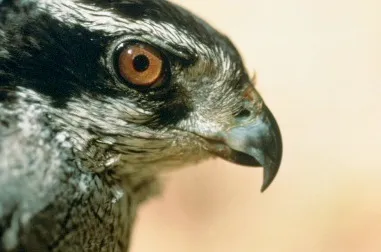
About goshawks: Several sightings of this magnificent bird of prey were reported in 2011 at the Château de Bourgon: **The first was accidentally caught in a fox trap in July 2011 and released as soon as it was discovered.
Species identification by David Madiot of the MNE: “Thank you for the photo—it leaves no room for doubt. It’s definitely a wood pigeon. This is not a juvenile, but an adult or subadult.”
“As for the sex, I wouldn’t venture a guess based on a photo, but according to your observations (the size of a buzzard), it’s most likely a female.” A northern goshawk had already been spotted about a year ago by Mr. D. Madiot in the Douglas fir grove in the Bourgon Forest, clearly visible from the castle.
So they have settled there. On October 15, 2011, another wood pigeon hawk was caught in the fox trap. This time it was a juvenile with a yellow eye and coarser markings on its chest.
Identified in photos and video by David Quinton. **The Northern Goshawk is a powerful, medium-sized diurnal raptor, but there is a significant size difference between the sexes. The male goshawk is approximately one-third smaller than his mate; he is about the size of a female sparrowhawk.
The female is similar in size to the common buzzard. The male has bluish-gray upperparts, while the female is slate gray. The underparts are whitish with fine gray streaks.
It has a broad white eyebrow above the eye, the color of which darkens with age. Pale yellow in juveniles, the eye turns bright orange in older adults. Its broad wings appear rounded in flight and are proportionally longer and more pointed than those of the female Eurasian Sparrowhawk.
It differs from the variable loon in that it has a longer tail. Its undertail coverts are downy and pure white. In flight, both sexes display prominent secondary flight feathers.
Juveniles differ from adults in their coloration. They are darker on top, and their undersides are mottled with coarse brown stripes.  Young goshawk, yellow-eyed **The goshawk has been partially protected in France since the ministerial decree of April 17, 1981, concerning birds protected throughout the country].
It is therefore prohibited to**kill, maim, capture, or remove it; to intentionally disturb or keep it as a pet; as well as to destroy or remove its eggs and nests; and to
destroy, alter, or damage its environment.
A formidable bird hunter, the northern goshawk is a diurnal bird of prey found in forested regions. It is larger than the European sparrowhawk and has a long, fairly broad tail.
Male: gray upperparts, pale gray streaked underparts, white undertail coverts, blackish parotics and crown, white eyebrow. Female: much larger than the male, weighing one and a half times as much. Same description, but much duller in color.
Its upperparts are grayish-brown, with lighter underparts.**It inhabits both coniferous forests (spruce, pine, and larch) and lighter deciduous forests such as oak and beech forests.
Like most birds of prey, It is very elusive outside the breeding season. The pair reigns unchallenged over a vast hunting territory that can cover 2,000 to 5,000 hectares.** The goshawks that nest in our region are sedentary and are joined in winter by birds from more northern or eastern regions.
Pairs form during the winter, and it is not uncommon to observe the early stages of courtship displays as early as December on beautiful, sunny days.** It is in early spring, during the mating season, that the goshawk is most easily observed.
The female takes the lead: she soars upward and then dives over the forest.**Singing occurs mainly in April. Sometimes the male and female fly together over their territory.
Their flight, with its slow, sweeping wing beats, resembles a kind of aerial ballet.**Once the pair has bonded, the male begins building the nest. However, if an old nest is nearby, the female repairs it and uses it.
It is usually found in a large tree, at a considerable height, between 10 and 30 meters.** In April and May, the female lays 3 to 4 eggs, which she incubates alone for 35 to 38 days.
The young birds fledge 36 to 40 days after hatching. They are able to hunt on their own about a month after fledging. Juvenile wandering leads the young birds to travel several dozen kilometers from their birthplace, while adults remain faithful to their territory year-round.
Its preferred prey includes birds of all kinds, including small birds of prey. Wild and domestic pigeons, as well as turtle doves, are a favorite part of its diet. Starlings, thrushes, blackbirds, crows, and jays are also favored prey.
Less commonly, it hunts gray partridges, but it also does not turn down young hares and wild rabbits. It is capable of hunting large prey thanks to its impressive strength, speed, and agility in flight.
The foreign birds that winter in our countries are mainly juveniles and tend to frequent open habitats such as plains and bodies of water.